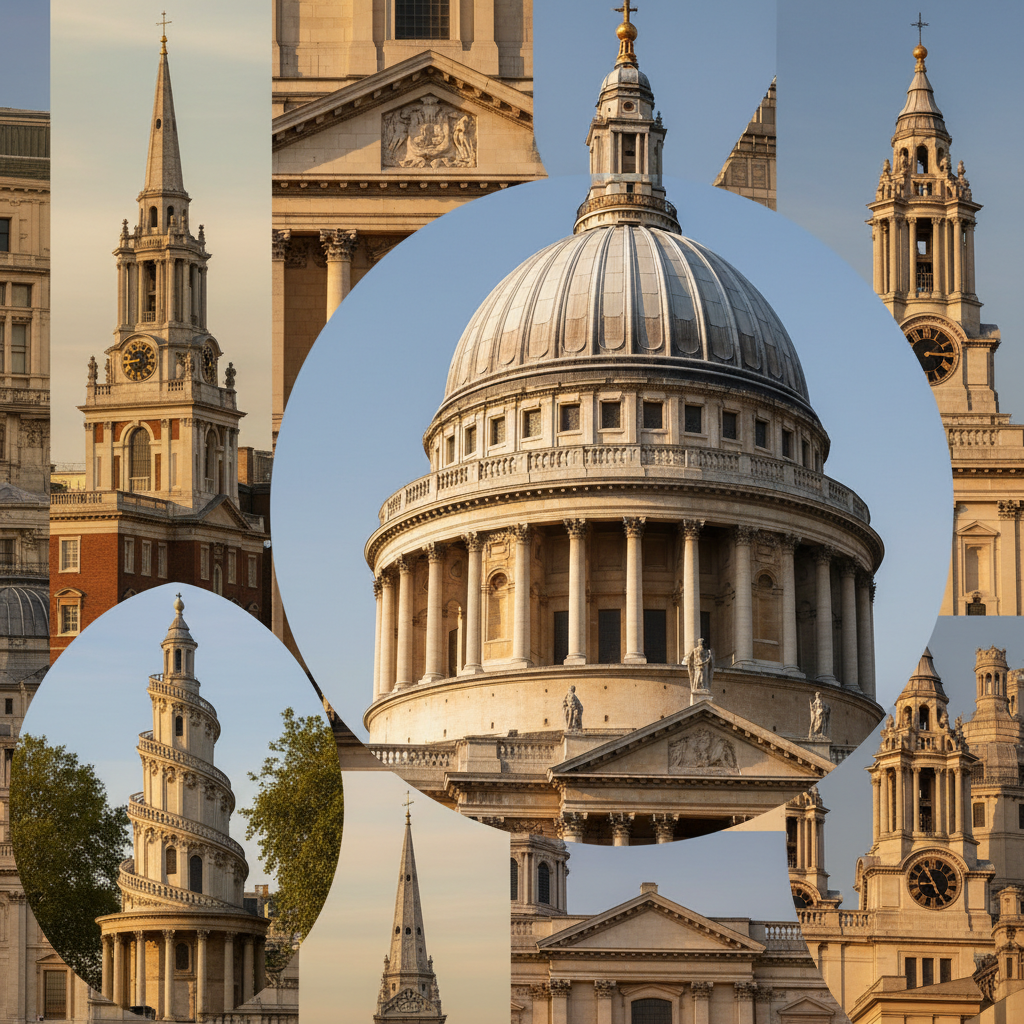
Sir Christopher Wren rebuilt 51 churches and St Paul's Cathedral following the Great Fire of 1666; these Christopher Wren churches London are renowned for their diverse architectural styles and iconic spires. Famous surviving examples include St Mary-le-Bow, St Stephen Walbrook, and St Bride's, which remain essential landmarks of the city's historic skyline.
You have walked past them dozens of times, perhaps without stopping, those elegant stone spires rising between glass towers in the City of London, easy to overlook when you are navigating a busy street or checking your phone for directions. But dismissing them means missing one of the most remarkable architectural stories in European history, a tale of fire, ambition, and one man's determination to rebuild an entire city skyline. Christopher Wren's churches are not simply old buildings preserved out of obligation; they are precision-engineered works of art, each with its own personality, its own peculiarities, and its own forgotten stories. In this guide, you will discover the history and genius behind these structures, the five churches worth rearranging your itinerary for, and the smartest ways to explore them on foot or by private black cab tour.
Who Was Christopher Wren and Why Does London Owe Him So Much?
Christopher Wren never trained as an architect. Before a single church spire rose from the ash of London's ruins, he had already made his name as an astronomer, a mathematician, and an anatomist whose work impressed the young Royal Society, of which he was a founding member. Architecture was, in the most extraordinary sense, a career change.
Charles II appointed him Surveyor of the King's Works in 1669, a role that placed him at the centre of the most ambitious building programme England had ever seen. The reason was simple and catastrophic. On the second of September 1666, a fire broke out in a bakehouse on Pudding Lane and did not stop burning for five days. When the smoke cleared, 87 of the City's 107 churches lay in ruins, along with thousands of homes, the old St Paul's, and the dense medieval fabric of the Square Mile.
It was a disaster on an almost incomprehensible scale. It was also, for a man of Wren's restless intellect, a blank canvas that no conventionally trained architect had ever been handed. What he did with it is the reason London's skyline still carries his signature more than three centuries later.
How Many Christopher Wren Churches Are There in London?
The direct answer is 52: Wren's office was commissioned to rebuild 51 City churches destroyed in the Great Fire, plus St Paul's Cathedral. Before September 1666, the Square Mile contained 107 parish churches, many of them medieval. The fire destroyed 87. Not all were rebuilt; some parishes were too small to justify reconstruction and were quietly absorbed into neighbouring ones, their congregations consolidated under combined vestries.
Of the 51 churches Wren rebuilt, 24 survive in largely intact form today. The rest have been lost to a second great fire in 1666's aftermath, Luftwaffe bombing during the Blitz, and 20th-century demolition driven more by commercial pressure than necessity. Several bombed shells were cleared after the war rather than restored, a decision that still provokes argument among historians and architects.
For anyone planning to visit the Christopher Wren churches London has retained, that figure of 24 is the practical starting point. They are not evenly distributed across the city, and opening hours vary considerably, which makes a mapped itinerary far more useful than a simple list. The sections ahead cover both the architecture and the individual churches in detail.
The Architectural Genius Behind the Spires: Wren's Design Philosophy
Knowing how many Christopher Wren churches London has retained is one thing. Understanding why they look the way they do is quite another, and it is where most accounts fall short.
Wren was drawn to Baroque architecture, the style sweeping Continental Europe in the seventeenth century: bold, theatrical, unashamedly dramatic. The problem was political. Baroque carried two associations that were deeply uncomfortable in post-Civil War England: Catholicism and France. Wren's solution was to strip the style back, keeping the classical vocabulary of columns, pediments, and curves while discarding the excess. The result was something distinctly English: ordered and restrained on the surface, but with enough sculptural energy in the spires and porticos to stop you in the street.
Two practical problems shaped almost every building he produced. The first was plot shape. The medieval City had grown without any grid, and the fire had not conveniently regularised it. Wren inherited irregular, often cramped sites where no two footprints were the same. Rather than imposing a standard template, he treated each plot as its own puzzle, which is why his churches reward comparison. The second challenge was light. Protestant worship placed the spoken word at its centre, so the congregation needed to see and hear the minister clearly. Wren answered this with large clear-glazed windows, open plans, and galleries that brought worshippers closer to the pulpit.
The dome became his signature response to both problems. At St Stephen Walbrook, built on a modest city plot, he constructed an intimate coffered dome supported on eight arches, working out structural principles he would later scale up dramatically for St Paul's. At St Mary Aldermary, where an existing structure and a donor's stipulation required Gothic forms, he produced fan vaulting in a Baroque building, one of the few moments where he bent his own aesthetic rules to suit circumstances.
Every constraint, it turned out, produced a different building. That variety is not accidental. It is the mark of an architect who genuinely solved problems rather than repeated solutions.
Five Must-Visit Wren Churches in the City of London
The variety in Wren's output means that choosing where to begin can feel overwhelming. These five churches, each representing a different facet of his work, give you the most rewarding return on a single day in the City.
St Stephen Walbrook, EC4N This is the interior that other architects come to study. The coffered dome, supported on eight arches rising from sixteen columns, fills what is essentially a modest city plot with a sense of genuine spatial drama. It was Wren's own laboratory for the structural ideas he would later apply at St Paul's. What most visitors miss is the telephone fixed to the wall near the entrance: the Samaritans were founded here in 1953 by the rector Chad Varah, and that original phone remains as a quiet, powerful reminder of the church's second life. Open most weekday mornings.
St Bride's, Fleet Street, EC4Y At 226 feet, this is the tallest of all the Christopher Wren churches London contains, and the tiered spire is its defining statement. Local legend holds that a Fleet Street baker used the silhouette as his model for the first tiered wedding cake, a story repeated at nearly every wedding breakfast since. Less romantic but arguably more significant: Luftwaffe bombing in 1940 stripped the floor away and revealed Roman pavements, Saxon foundations, and a medieval charnel house beneath. The crypt museum tells this story well and is free to enter.
St Mary-le-Bow, Cheapside, EC2V To be born within earshot of the Bow Bells is the traditional definition of a Cockney, which makes this one of the most culturally loaded buildings in London. The golden dragon weather vane on the tower is easy to spot from street level. Less visible but worth knowing: the bell inscriptions reference Dick Whittington, connecting the church directly to the medieval legend of the boy who heard the bells calling him back to London.
St Benet Paul's Wharf, EC4V This small, dark-brick church a short walk south of St Paul's is arguably the least altered of all Wren's surviving buildings, its hipped roof and carved garlands unchanged since the 1670s. It also holds a distinction no other Wren church can claim: Welsh-language services every Sunday, maintained by the London Welsh community since 1879. It is chronically overlooked, which is precisely why it belongs on this list.
St Mary Abchurch, EC4N Tucked behind Cannon Street, this is the church that rewards those who go looking. The painted dome interior, decorated by William Snow with a trompe l'oeil effect, is the kind of thing you do not expect to find in a building this modest from the outside. The Grinling Gibbons carved reredos, one of the finest pieces of woodcarving in any City church, survived the Blitz intact. Both details together make a strong case for treating this as a destination rather than a detour.
Hidden Stories You Will Not Find in the Standard Guidebooks
The five churches above reward any visitor who makes the effort to find them. But the stories that tend to stay with you are rarely the ones printed on the information boards.
At St Stephen Walbrook, that elegant interior hides a practical humiliation from Wren's own lifetime. The north door, which should have opened onto the street, was bricked up within a few years of the church's completion. The reason was the Stocks Market next door, where slaughterhouses produced a smell so persistent and so offensive that sealing the entrance was the only workable solution. The door's ghost is still visible in the stonework.
St Clement Eastcheap has a credible claim to being the church in the Oranges and Lemons nursery rhyme, a detail that becomes considerably more interesting when you discover the rhyme was originally a guide to London's debt geography rather than a children's song.
At St Vedast alias Foster Lane, near Cheapside, Agatha Christie was a regular parishioner. Her husband, the archaeologist Max Mallowan, donated a cuneiform inscription that still sits in the courtyard, an incongruous piece of ancient Mesopotamia in the heart of the City.
St Andrew-by-the-Wardrobe, close to Blackfriars, counted William Shakespeare among its parishioners during his years working at the nearby Blackfriars Theatre. The connection is documented rather than mythologised.
Finally, St Bride's patron saint, the Irish St Bride, was reputedly capable of turning bathwater into beer, a miracle that has endeared her to Fleet Street ever since.
Wren's Masterpiece: St Paul's Cathedral Up Close
Every church on the list above is, in some sense, a rehearsal for this one.
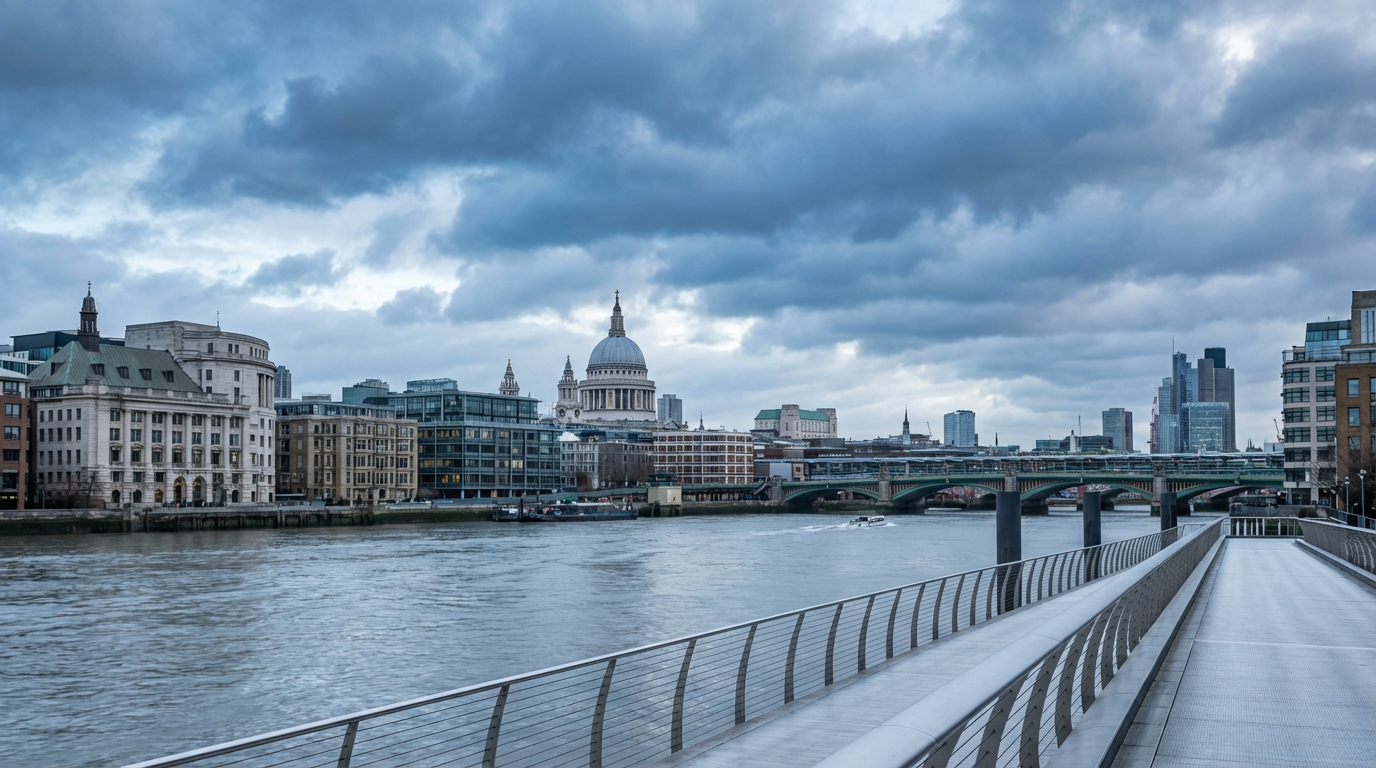
Construction of St Paul's Cathedral began in 1675 and was not completed until 1710, thirty-five years during which Wren oversaw every detail while continuing to rebuild the City around it. He had a preferred design: the Great Model, a centralised plan modelled on St Peter's in Rome, which he considered architecturally superior. The clergy disagreed and insisted on a traditional longitudinal plan. Wren compromised, then quietly found ways to impose his own vision anyway.
The dome is the clearest example of his thinking under constraint. It is actually three shells, not one. The outer dome gives St Paul's its commanding presence on the skyline. The inner dome creates the correct proportions when you look up from the nave. Between them, a hidden brick cone carries the weight of the stone lantern above. No single shell could have achieved all three functions; Wren solved the problem by refusing to choose between them.
For over 250 years, until the BT Tower opened in 1965, St Paul's was the tallest structure in London. During the Blitz, incendiary bombs fell around it repeatedly, yet the cathedral survived largely intact. Photographs of its dome rising through the smoke became one of the defining images of wartime London, carrying a symbolic weight that no government press office could have manufactured.
Wren is buried in the crypt below. His epitaph, written by his son and set into the floor, asks nothing elaborate of the visitor: Lector si monumentum requiris, circumspice. Reader, if you seek his monument, look around you.
How to Explore the Wren Churches: Walking Routes and Black Cab Tours
That epitaph is a fitting note on which to turn from the cathedral and think about how to actually see what Wren left behind.
The good news is that most Christopher Wren churches London has retained are clustered within a compact area of the Square Mile, within roughly a mile of St Paul's. In theory, you could walk between them in a single morning. In practice, the medieval street pattern that Wren himself inherited makes navigation slower than any map suggests, and the opening hours add a further complication. Many of these churches open only during weekday lunchtimes, typically noon to two o'clock, which means a poorly sequenced route can leave you standing outside a locked door more than once.
A guided Wren churches tour by black cab removes both problems. A knowledgeable driver knows which churches open when, can sequence the route to avoid clashes, and reach drop-off points in the narrow lanes around Cannon Street and Cheapside that pedestrians often walk straight past. Crucially, the itinerary bends around you rather than the other way around.
For travellers arriving at Heathrow, Gatwick, or the London terminals early in the day, the Arrive and Explore package pairs your airport transfer directly with a guided tour, filling the hours before hotel check-in with something genuinely memorable rather than a wait in a lobby.
London’s landscape was forever changed by the architectural vision that followed the Great Fire. These sites represent more than just stone and mortar; they are symbols of a city’s enduring spirit. While self-guided walks are a wonderful way to see the sights, many visitors find that a guided approach brings the history to life. If you want expert help discovering the stories behind the Wren Churches, we would be delighted to show you the hidden details that many people miss.